
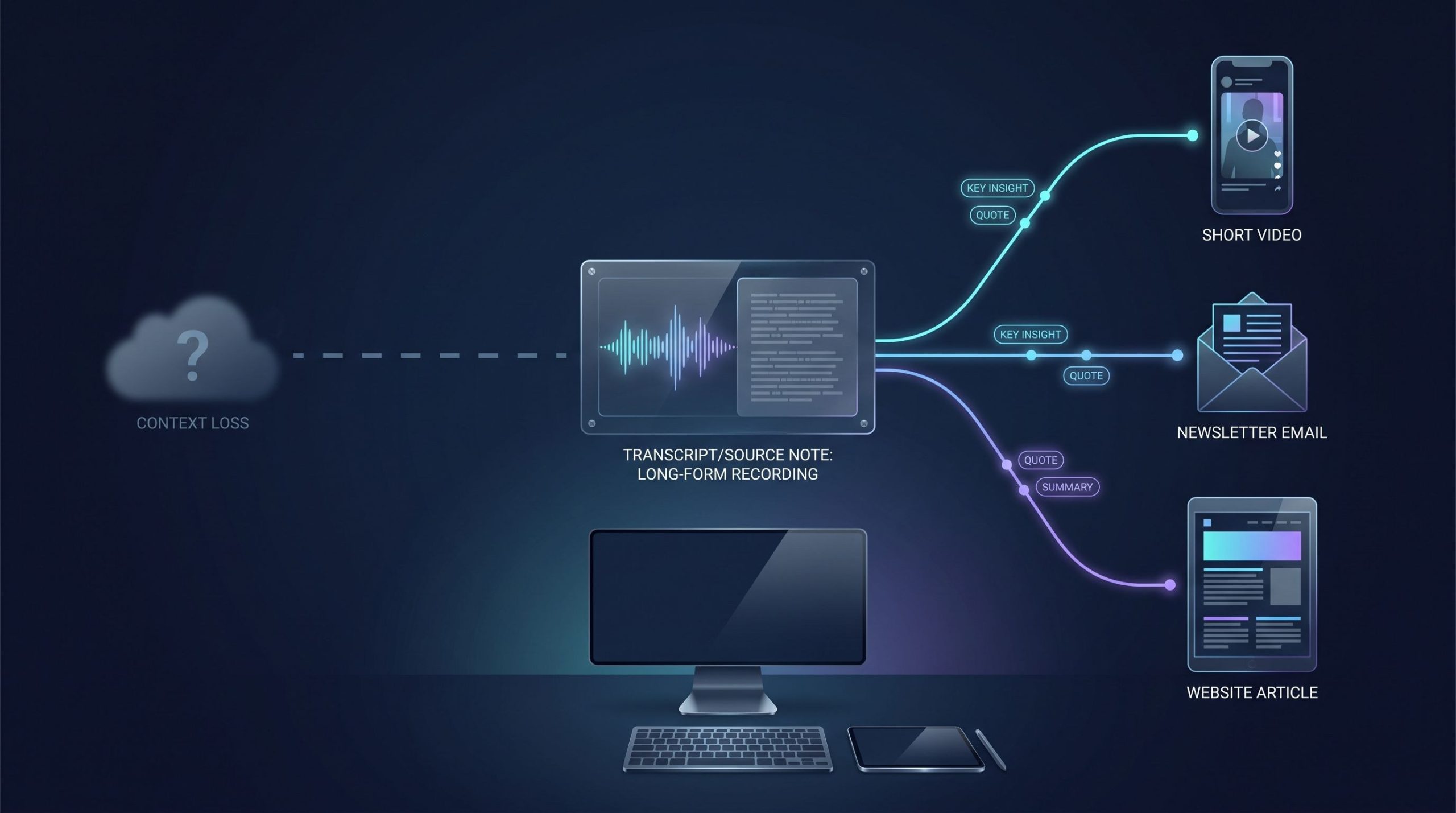

AI can now turn one podcast or long-form video into a Short, newsletter, article, and several social posts faster than most creators can review them.
That speed is useful. It also creates a new failure mode.
The more formats an AI agent produces from one source, the easier it becomes for a caveat to disappear, a “may” to become a “will,” or an announced feature to start sounding available today.
The hard part is no longer just generating more content.
It is keeping the source intact while the format changes.
YouTube is turning editing into a conversation
At Made on YouTube on September 23, 2026, YouTube announced a Gemini-powered conversational editing assistant for Shorts and the YouTube Create app.
YouTube says creators will be able to start with suggested prompts or their own instructions, build a first draft, keep refining it conversationally, and jump back into the manual timeline whenever they want more control.
This is still an announced capability, not something WithAIM has tested. TechCrunch reports that conversational editing is planned for early 2027.
The bigger shift is what happens after editing becomes easier.
One source can become more formats, faster. That makes preserving the source more important, not less.
The hidden problem with AI content repurposing
Imagine an interview contains this statement:
The company may release the feature early next year.
The Short wants a stronger hook.
The newsletter wants a clear argument.
The blog article wants a concise answer.
The social post wants one sentence.
After several AI adaptations, that original statement can quietly become:
The feature launches early next year.
The content is cleaner.
It is also no longer saying the same thing.
This is context drift.
It usually does not happen because the AI invents an entirely new story.
It happens through small changes:
- “may” becomes “will”
- an announced feature starts sounding available today
- a hypothetical example starts reading like firsthand experience
- a caveat disappears because it weakens the hook
- one source becomes several increasingly confident summaries
The more content you automate, the easier these changes are to miss.
A 4.23-second success that proved almost nothing
I recently connected WithAIM’s WordPress site to a draft publishing workflow.
The connection test authenticated with WordPress, read an existing draft, submitted an unchanged excerpt, reread the post, and confirmed the checked editorial fields remained unchanged.
The post also remained a draft.
The test completed in 4.23 seconds.
Technically, the test passed.
Editorially, it proved almost nothing.
A successful save does not verify editorial quality.
The API can successfully save an article.
An AI editor can successfully cut a video.
An automation can successfully generate a newsletter.
None of those technical checks tell you whether the meaning survived.
That requires a different kind of system.
The bottleneck is moving upstream
The traditional creator workflow looked something like this:
Record → edit → publish
Editing was often one of the slowest parts.
AI-assisted workflows increasingly look more like this:
Source → AI processing → Short + newsletter + article + social posts
The transformation gets faster.
The source therefore becomes more important.
If every output is generated independently, each one becomes another opportunity for the content to drift away from what was actually said.
Instead of only building faster creation systems, creators need to build a reliable source layer underneath them.
Build a source packet before you automate
Before an AI agent starts generating different formats, give it one approved source packet.
That packet has five parts.
1. Approved source
Identify exactly what the content is based on.
That could be:
- the original podcast recording
- an interview transcript
- a research paper
- an official announcement
- a dataset
- a product changelog
- an approved script
Do not let every AI task independently research the topic again unless that is intentional.
Start from the same source.
2. Claim ledger
Pull out the important factual claims from the source.
For each significant claim, record what supports it.
This matters particularly for:
- dates
- statistics
- product capabilities
- quotations
- timelines
- causal claims
- pricing
- availability
- anything likely to change
The goal is not to create a complicated research database.
It is to make important claims easy to verify.
3. Qualification note
Record everything the AI should not accidentally make stronger.
For example:
- announced, but not released
- tested by someone else, but not by you
- hypothetical example
- estimate rather than confirmed number
- limited availability
- disputed interpretation
- correlation rather than causation
These are often the first details lost during repurposing because they make copy less punchy.
They are also often the details that keep the content accurate.
4. Format brief
Now tell the AI what should change.
A Short and a blog article should not sound the same.
For a Short, you may prioritize:
- one argument
- a strong opening
- fewer details
- visual clarity
For a newsletter:
- an interesting idea
- an explanation
- opinion or interpretation
- something useful to try
For a website article:
- search intent
- supporting detail
- definitions
- examples
- internal links
- long-term usefulness
You want the format to change while the facts remain stable.
5. Final source check
Before publishing, compare the output against the source packet.
Ask:
- Did any claim become more certain?
- Did a date or number change?
- Did we imply firsthand experience we do not have?
- Did an announced feature start sounding available?
- Did an important qualification disappear?
- Did the headline overstate what the source supports?
An AI agent can run much of this comparison, but only if it has a fixed source to check against.
The check should exist before anything goes public.
Use this prompt before you repurpose anything
Before generating multiple pieces of content, give your AI this instruction:
I am going to adapt one approved source into several formats.
First build a source note with:
SUPPORTED CLAIMS
List the claims the source directly supports.
QUALIFICATIONS
List anything that is announced but not released, uncertain, hypothetical, limited, estimated, or not personally tested.
DO NOT CHANGE
Identify dates, numbers, names, causal claims, and caveats that must remain accurate in every adaptation.
FORMAT GOAL
For each output, explain what should change to fit the platform without changing the underlying facts.
FINAL CHECK
After drafting, compare every factual claim against the source note. Flag anything that became stronger, broader, or more certain than the source allows.
Do not invent firsthand experience or fill missing facts with assumptions.
One source, four different jobs
Suppose you have a 45-minute podcast interview.
The podcast remains the complete source.
For YouTube Shorts, identify a self-contained moment with enough context to stand alone.
For the newsletter, extract the strongest argument and explain why it matters.
For the website article, answer a durable question people may continue searching for months later.
For social posts, isolate useful observations, quotes, or frameworks.
Each output can have a different hook and structure.
They should all share the same factual foundation.
This is especially important for creators publishing across podcasts, YouTube, newsletters, and websites.
The goal should not be:
Make every format identical.
It should be:
Let every format do its job without changing what the source actually supports.
For more podcast production, growth, and publishing resources, the WithAIM Learn library can serve as the internal reference hub while the new AI-creator content library grows.
What the human still owns
AI agents can increasingly handle execution: research, editing, drafting, organizing files, preparing posts, and moving work between systems.
The human role is not to manually repeat every step.
It is to define what the system is allowed to change and what it must preserve.
You still own:
- which source is trustworthy
- which claim is actually worth publishing
- which caveat cannot disappear
- which angle fits the audience
- which experience is genuinely yours
- what requires approval
- what the agent can handle independently
That is not a smaller role. It is a more precise one.
The rule for a reliable creator system
The first phase of AI content creation was about generating more.
The next phase is about building systems that stay reliable as they produce more.
The operating rule is simple:
One source. Many formats. Context intact.
Automate the transformation.
Do not automate away the truth that made the source useful in the first place.
Creator CTRL — Create like yourself. Operate like a team.


0 Comments